

When Did They Draw The Cave Paintings
Cavern paintings and drawings were the first uses of fine art in prehistoric times. Hither nosotros look at the these creative interpretations of the world byHomo sapiens.
Introduction to cavern art
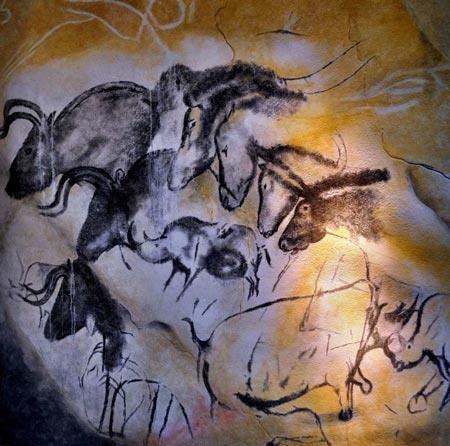
- Describe what y'all run into.
- What do you call up it was painted on?
- How sometime do you recall information technology is?
- Why do you recollect it was drawn and painted?
We call this cavern art. It was painted on the walls of caves in Europe and in Asia during the Palaeolithic Period some 325 one thousand thousand to 10,000 years ago. To go far easier to talk virtually events the period is cleaved upwardly into 3 periods.
The Palaeolithic period and humans
The start is the Lower Palaeolithic. It was dominated past a number of human-type people and later past the Neanderthals. Then around 300,000 years agone, nosotros call this the Middle Palaeolithic followed by the Upper Palaeolithic (Table i).
Table 1: Timeline of Palaeolithic Period from 325 1000000 to x,000 years ago.
| Years ago | Period | People | Paradigm of Civilisation |
| three,500 30,000 | Upper Palaeolithic | Man sapiens Cavern art with animals appears | © Giovanni Caselli |
| 30,000 35,000 | Transition Centre to Upper Palaeolithic | Homo sapiens spread across Europe Homo neanderthalensis have disappeared | Courtesy of NASA/JPL-Caltech |
| 35,000 40,000 200,000 300,000 | Middle Palaeolithic | Outset cave fine art Human sapiens arrive in Europe Homo neanderthalensis appear in Europe | Christian Jegou Publiphoto Diffusion / Science Photograph Library |
| 300,000 one.6 million i.ix million 2.3 million 3.four million | Lower Palaeolithic | Hand axes announced Man erectus (Africa) Human habilus (Africa) | Past T. Goskar and K. Nichols, copyright Wessex Archaeology |
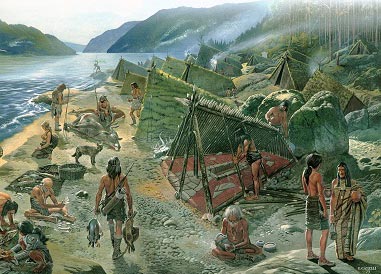



The Upper Palaeolithic Menstruation is very unlike from the Middle and Lower periods. People wait different and the culture (ideas, customs, and social behaviour) of the people are different. Over the different periods humans were mostly hunter-gathers who used tools and fire, and from the Lower menstruation onwards they seem to take buried their expressionless.
Differences between Neanderthals and Homo sapiens
It would be wrong to try and explicate the success of Homo sapiens in the Upper Palaeolithic past thinking that they were more intelligent than the Neanderthals (Homo neanderthalensis) of the Lower and Center Periods.
Maybe it was the development of language, since it is articulate from the evidence that Neanderthals were tool-makers and lived in groups. It'due south not clear if they had a language but their brains were approximately the aforementioned size as Homo sapiens.
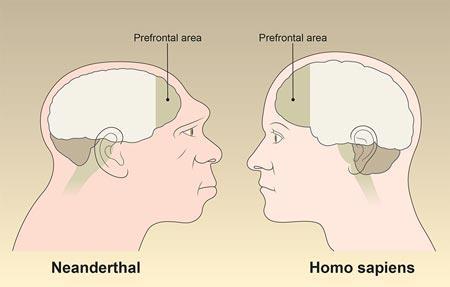
Studies of the brains chapters and structure imprint on the skull to determine encephalon arrangement by Dunbar and Pearce (2013 Science Daily) accept suggested that information technology is possible Neanderthals could have produced other things besides tools. In fact Neanderthals brain development indicates an increased evolution in the sensory especially vision and motor centres, primarily in the rear half of the brain. Homo sapiens show a different type of development, primarily in the frontal lobes. These are the higher thinking centres of the brain, and indicate a development in speech, imagination, and ethics centres.
Testify of early art
It is clear that ane departure is that the Upper Palaeolithic people produced complex communication and art. Even in this area though there needs to be care, and the complexity of this inquiry area tin be illustrated by the Makapansgat cobble from South Africa.
This cobble is a red jasper (silicate mineral containing iron oxide) stone which appears to have the shape of a caput. It seems to accept been carved with distinctive 'staring eyes' and a 'oral fissure'. Firstly we know that jasper could not have occurred naturally in the dolomite cavern where it was institute, so it must have been carried there.
Secondly, the markings practise not appear to exist natural they behave all the impressions of having been carved.
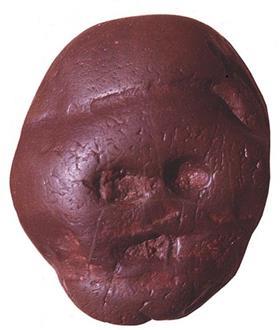
Thirdly, because of the place it was found in and the materials effectually information technology, information technology has been suggested that it was deposited in the cave by Australopithecus africanus. They were ascendant in the Lower Palaeolithic Catamenia about 3 million years ago. [i] That is a long time earlier Human neanderthalensis let lonely Homo sapiens.
Bednarik who studied this cobble claims that, sometime around 850,000 years agone, the people of the Lower Palaeolithic were engaged in behaviour which could be interpreted every bit 'art'. Evidence shows they decorated themselves with beads, nerveless exotic stones and there is evidence of the collection and use of ochre equally a ornament.
- Is this evidence of a spiritual development?
More substantial evidence of this spiritual grapheme, that could have led to cave art, is burials from the Lower Palaeolithic period about 350,000 years ago. These burials comprise grave appurtenances and the people used colour on their bodies in the form of tattoos.
These tattoos are drawn using such minerals as ochre, manganese oxide or charcoal. Later they painted on cave walls using lines, circles and 5 markings. It is later in the Upper Palaeolithic catamenia that there is the advent of carved anthropomorphic (animate being and human) images with strange symbols and marks and the creation of cave paintings.
All this evidence would suggest Palaeolithic humans had begun to believe in supernatural or spiritual beings early. [ii] Indeed, Lewis-Williams [three] argues this behaviour has its evolutionary origins in Africa as a cistron of human consciousness.
The Importance of cave fine art and human development
Information technology can be argued that nosotros have e'er nerveless things and doodled, so how is that continued to the cave paintings?
Archaeologists argue that collecting is connected to ritual (a series of actions performed according to a prescribed order) and that is an indicator of a conventionalities organisation or religious behaviour. So ritual and organized religion is an essential mark of modernistic human behaviour. It has been said that it displays the emergence of the modern mind.
From the evidence available information technology is assumed that this aspect of man behaviour emerged around 40 - 50,000 years ago. If that is true, information technology's the transition from the Centre to Upper Palaeolithic period and the advent of the mod human.
Cave painting is considered one of the first expressions of the human being animal'south appreciation of dazzler and a representation of a mystic or sacred side to life. Hundreds of images of animals in vibrant colour and striking poses of action tin can be seen in the prehistoric art gallery on rocks worldwide. There are many examples in France and Spain.
These cavern wall paintings are known as pictographs and are establish all over the globe alongside petroglyphs (the incised, pecked or cutting designs on stone surfaces).
Cave drawings are they art?
Weren't they used for teaching young hunters?
The give-and-take art does not appear before the fifteenth century so the Palaeolithic people did not know it as fine art. Using the give-and-take fine art from the 15th century means that the Egyptians, Greeks and Romans had no word for art.
In fact art is a Center English word coming from the Latin ars (skill or technique). The first use of the word art was when it was used to show a mark of human achievement in the early on universities and that exists today in the Bachelor of Arts (BA) or Principal of Art (MA) awarded by universities.
Yet, fine art is more than a skill or technique. It has a purpose going across making something. Any connectedness with our modern use of the word art did not appear until the late 1600s.
Then it is possible some of the pictures were used to teach immature hunters merely and then many of them accept other characteristics that mean at that place had to have been links with some belief system.
Were all the cave paintings of animals?
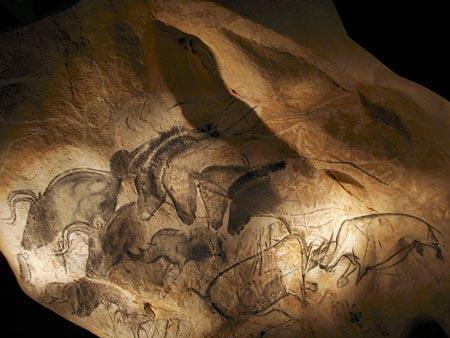
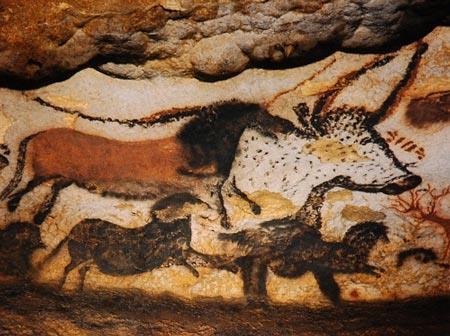
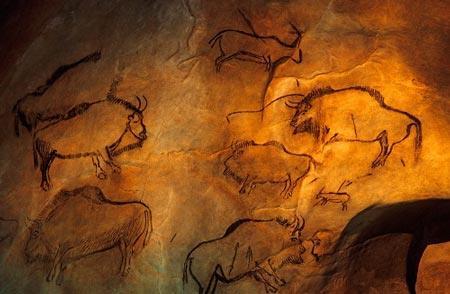
No, in El Castillo cave, Northern Spain, there are Palaeolithic paintings. These are stencils of easily and disks made by blowing paint onto the wall and appointment dorsum at least 40,800 years'. This makes them Europe's oldest known cave art.[four] In France the cave paintings of Chauvet have been dated to 33,000 years ago; the paintings found at Lascaux to 17,000 years agone; and those at Niaux betwixt 14,500 and 13,500 years agone. Each fix of paintings show differences and a development in style of representation.
In Chauvet the drawings describe animals. It is suggested that these correspond the animals that provided the people with food and raw materials along with the predators that endangered or competed with them. The Lascaux paintings, on the other hand, show depictions of strange beasts such as ones that are half-human being and half-bird and others that are half-homo and half-lion. Those in Niaux are depicted as a huge frieze showing bison, deer, ibex, and horse and there are carvings showing salmon or trout and bears claws.[v]
Consequently, some archaeologists take seen these representations as indications of the development of a grade of religion. The paintings in Niaux were made equally the Last Glacial Maximum began to warm and seem to be an impression of the animals around the people, indicating a spiritual expression of existence.
Distribution of cave drawings
In that location are very unlike drawings in each cave, but were paintings the just things the people produced and were French republic and Spain the only places?
The distribution of cavern art is worldwide just in Eurasia information technology is virtually abundant in areas that are also rich in decorated objects including:
- the Périgord, the French Pyrenees, and Cantabrian Spain;
- Portugal, where there are Palaeolithic busy caves;
- the very south of Spain to the north of French republic;
- southwest Germany, where traces accept been found;
- Italia and Sicily, which have some concentrations;
- Slovenia, Romania, Republic of bulgaria and Russia.
The current total for Eurasia is nearly 280 sites. Some similar Creswell Crags, England, incorporate simply one or a few figures on the walls, others similar Lascaux or Les Trois Frères have hundreds.
The following map shows the limits of the Final Glacial Maximum. It as well shows the main sites of cave fine art in Eurasia and though not fully inclusive of all cave art it is a good indicator of the spread.
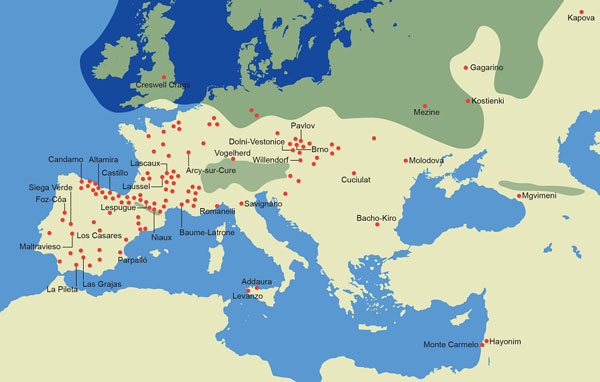
Distribution of primary Palaeolithic cave-art locations in Eurasia. Peter Bull.
It'south interesting to note that so many cave art sites are establish in groups while some are just single sites. Notwithstanding, information technology would be unfair to draw too many conclusions from this map since in that location are so many factors affecting the presence of cavern paintings. The about important is the climate of the area. So, equally only a few accept been establish in the temperate wet climate of United kingdom, so does that mean the people in the British Isles drew little cave art or has the majority been eroded away?
A hit feature of many of these cavern paintings is the fact that they are often in large caverns with interesting sound qualities.
- So, was singing or chanting some other aspect of the art feel for the Palaeolithic peoples?
The evidence would be the beingness of musical instruments, and flutes from 42 - 40,000 years ago made from bird os have been found and reconstructed. They show the people had an understanding of how length, bore and position of holes influenced the audio.v Did they play just one instrument at a time or did they play in groups? We tin can simply wonder at the sound these people produced.

Source: https://edu.rsc.org/resources/cave-art-history/1528.article
Posted by: burtonroomens.blogspot.com
0 Response to "When Did They Draw The Cave Paintings"
Post a Comment