

What Did Elizabeth 1 Use For Makeup
The Real Story Behind Margot Robbie's Wild Queen Elizabeth Makeup
Elizabeth I is famous for her face powder. Why she wore information technology and whether it poisoned her is complicated.
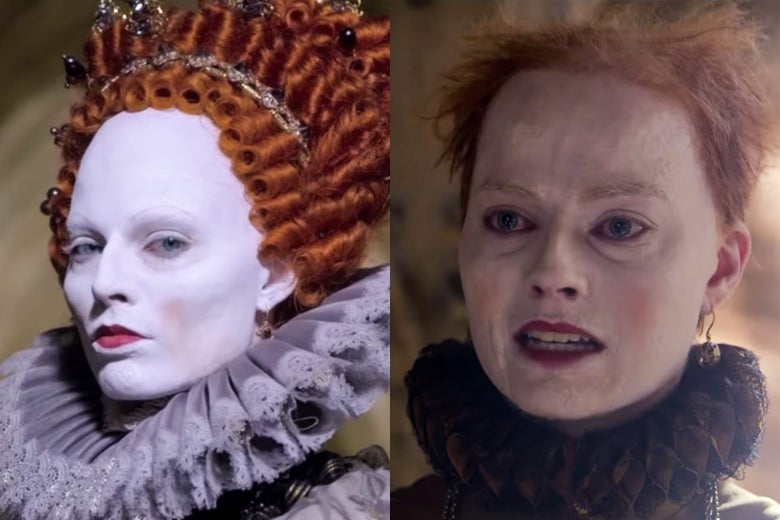
Mary Queen of Scots opens on Friday, featuring Saoirse Ronan equally Mary and Margot Robbie as Elizabeth I. In Robbie's Elizabeth, we get the latest filmic representation of the queen'due south famous chalk-white confront and brilliant-red wigs. Interviews with Robbie take understandably focused on the remarkable makeup and prosthetics the coiffure created for the extra, though not anybody loves the await—my colleague Inkoo Kang hilariously called it "perilously close to Ronald McDonald cosplay" in her review. The motion picture doesn't really delve into the question of Elizabeth's makeup directly, simply her shockingly white face up is a deeply woven part of the historical prototype of this atypical queen, and it's worth unpacking in greater particular.
In our historical retentivity, Queen Elizabeth I owed her clown-white face to ceruse—a class of powdered atomic number 82. Archaeologists have found traces of white pb in the graves of upper-class women who lived as far back as ancient Hellenic republic, Lisa Eldridge reports in her history of makeup. Nor were the Greeks the only ones in the aboriginal globe to hit upon the thought of using lead to whiten. Eldridge writes that ceruse—the cosmetic powder produced via a procedure combining lead and vinegar—may accept been in utilize in aboriginal Communist china equally early on every bit the period of the Shang Dynasty (c. 1600–1046 B.C.)
In Europe during the Renaissance, "women in both city and land used cosmetics freely, unaffected by satires and sermons and the unfortunate effects of poisonous ingredients," Richard Corson writes. Corson adds that ladies who could beget it sometimes practical one coat of ceruse powder on peak of another—"either to avoid the trouble of removing the paint each day, or in order to make full in wrinkles." Cervix and décolletage received a coating as well. Other whitening preparations included powdered borax and sulphur, only ceruse was the most effective. The type branded "Venetian ceruse," also called "spirits of Saturn," was, Eldridge writes, "the virtually fashionable, expensive, and toxic pare whitener available in the sixteenth century"—so expensive that elite (and royalty) were its major users.
When young, Elizabeth (who ruled from 1558 to 1603) was, reportedly, a naturally good-looking woman. Eldridge writes that a visitor to courtroom when Elizabeth was 24 described her as "comely rather than handsome … tall and well-formed, with a good skin, although swarthy; she has fine eyes and above all, a cute manus with which she makes display." Equally Eldridge points out, Elizabeth'south female parent, Anne Boleyn, "was reported to have olive skin," which accounts for the mention of "swarthiness." Merely information technology'southward difficult to tell for sure what Elizabeth looked like, considering, as scholar Anna Riehl argues, contemporary documents of the queen's physical appearance—be they textual reports or artistic productions—were e'er partially political. People perceived a queen's dazzler as a sign of her divine right to rule. As Elizabeth'southward reign proceeded, perceptions of her concrete dazzler and her power were always more entangled.
Elizabethan women had their reasons for wishing to nowadays a totally white face up—the appearance of youth and fertility; conformity to an ideal of beauty that demanded women await like they never worked outside in the sun. (Despite racial undertones that read as very familiar to us today, the prioritization of whiteness in female beauty in sixteenth-century England seems to have had more than to do with classism than racism. Gimmicky sources show that anti-black racism was present in Elizabethan culture; notwithstanding, every bit my colleague Jamelle Bouie recently wrote, refinement of the kind of widespread hierarchical racist thinking that we know today came later on, during the Enlightenment.)
Merely Queen Elizabeth'south relationship to her ain torso and her presentation was even more complex. She was a female ruler and remained unmarried. Throughout her reign, there were those who questioned her right to be on the throne. The unusual fact of her queenship meant that her body was under substantial scrutiny. "The torso politic of English kinship was incarnated in the natural body of an unmarried woman," Louis Montrose writes, which "ensured that gender and sexuality were foregrounded in representing the Elizabethan state."
During her reign, Elizabeth became an icon to worship—the Protestant object of a "purple cult" that, Montrose reports, clashed with and contested the Catholic worship of the Virgin Mary. This "cult of Elizabeth," which emphasized her virginity and beauty, provoked a range of responses among Britons, who "sustained, elaborated, and appropriated [the cult] to their own ends" during her time in power. Living within it all, Elizabeth clearly seemed to realize her presentation of a mask that didn't slip was critical to her survival.
Did Elizabeth utilise ceruse to excess, as most every filmic representation of the queen from the 20th and 21st centuries would have us believe? Elizabeth had smallpox in 1562, which manifestly left her with tell-tale pocks (or pits) on her face up. The combination of her "swarthiness," these blemishes, and the aging process (which would have been abetted by the utilize of the toxic lead pulverisation) may have led her to apply notwithstanding more ceruse as time went on and her peel became more and more unsightly. That might have resulted in a clownish appearance, like Robbie'south in the latter part of the new Mary Queen of Scots.
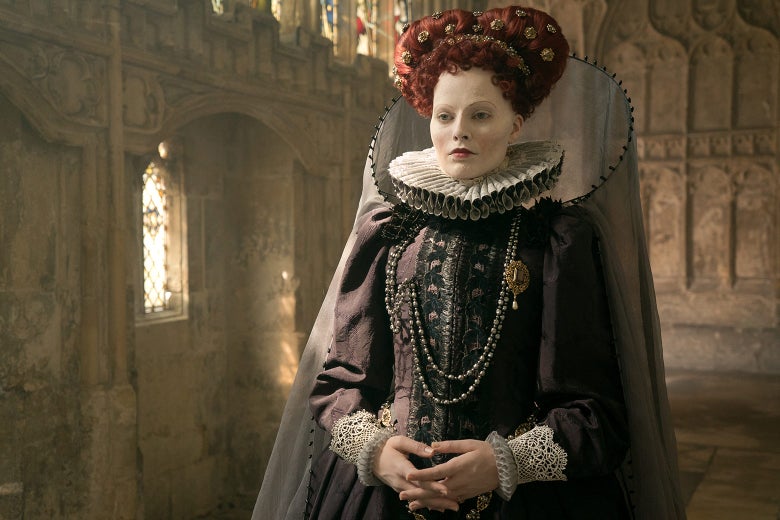
Simply, Anna Riehl argues, there are very few gimmicky testimonies to Elizabeth'south supposed ceruse overuse. One very colorful reference from belatedly 1600 is often repeated in later on histories—the aging Elizabeth, according to this account, "was continuously painted non just all over her face, but on her very neck and breast besides … the same was in some places near half an inch thick." Just this account seems to take been a street rumor, "picked up by Begetter Rivers, a Jesuit in hiding" during a time when Catholics (especially Jesuits) were persecuted in England. Riehl sees Rivers' report as unlikely to be true in every detail, only historically of import nonetheless because it shows how Elizabeth's critics used her habit of "painting" against her.
Even if they didn't directly criticize Elizabeth for it, her gimmicky (male) writers hated the very beingness of ceruse. Andreas de Laguna, a physician to Pope Julius Three who Corson cites in his history of makeup, said the paint had been invented past the devil. Firenzuola, an Italian monk (who used a unmarried name), published a book on platonic Renaissance dazzler in 1548. Firenzuola decried employ of the paint every bit an instance of women's ridiculousness. "These foolish maids," he wrote, "believe that men, whom they seek to please, practise not discern this foulness, which I would have them to know wears them out and makes them grow old before their fourth dimension, and destroys their teeth, while they seem to exist wearing a mask all the year through."
Religious writers fabricated the use of ceruse and other cosmetics a detail business organisation. Philip Stubbes' The Anatomie of Abuses (1583) included a religious critique of cosmetics: "Thinkest 1000 that thousand canst make thy self fairer than God who fabricated usa all? These must needs be their inventions, or else they would never go nearly to colour their faces with such sibbersauces." ("Sibbersauces"! Put that obsolete synonym for "concoction" in your pocket for later.) Puritan Thomas Tuke wrote in a 1616 Discourse Against Painting and Tincturing: "A painted face is a false confront." He charged that women who used ceruse were "ugly, enormious [abnormal], and abominable," and that one could "hands cut off a curd or cheese-cake from either of their cheeks."
Our historical understanding of Elizabeth's decline has been built around her thwarted vanity. Elizabeth was 69 when she died, and had been queen for 45 years. Ben Jonson wrote, sixteen years after her decease, that Elizabeth "never saw herself afterward she became old in a true drinking glass"; according to this story, her servants painted her, and sometimes had fun by putting vermilion (a ruby pigment) on her nose, knowing that she'd never run into it. Anna Riehl wonders how truthful this anecdote is. Was Jonson reporting a truth or "indulging the younger generation's frustration with an aged monarch"? Either way, Riehl sees the story as reflecting "a typical misogynistic distrust of the perceived vulnerability and waning power of the aged queen."
How did Elizabeth die? Blood poisoning from all that white face pigment she may have relied upon? Pneumonia, strep, cancer? No postmortem was performed on her body, so we will never know. By the end of her life, she had lost all her teeth and was largely incapacitated. The Royal Museums of Greenwich, on a page about the myths and mysteries that still surround Elizabeth's death, writes that Elizabeth Southwell, one of the queen's ladies-in-waiting, "reported that the Queen was haunted by visions of her frail body," and that "her corpse was and so full of noxious vapours that information technology exploded in her pb coffin." (Dryly, the museum adds: "Southwell proved to be an unreliable source after she converted to Catholicism post-obit the Queen'due south death.")
Southwell and Jonson aside, cultural representations of Elizabeth's old age and death were largely kind until the second function of the 19th century, when, Michael Dobson and Nicola J. Watson write, "Elizabeth would actually be discovered equally a ridiculous, if dangerous, old fraud." Her use of cosmetics and wigs became central to this image. Writers and painters began to depict Elizabeth as a preposterous and vain one-time maid. Satirically represented by the writer Walter Savage Landor, she's described as "a skinny erstwhile goshawk, all talon and feather." In 1848 Augustus Leopold Egg exhibited his painting Queen Elizabeth Discovers She Is No Longer Immature , a re-creation of a supposed incident when the onetime queen looked in a mirror for the first time in years. Dobson and Watson describe the painting as "punitive," a work of art that crystallizes "the Victorians' unprecedented preoccupation with Elizabeth'due south old historic period."
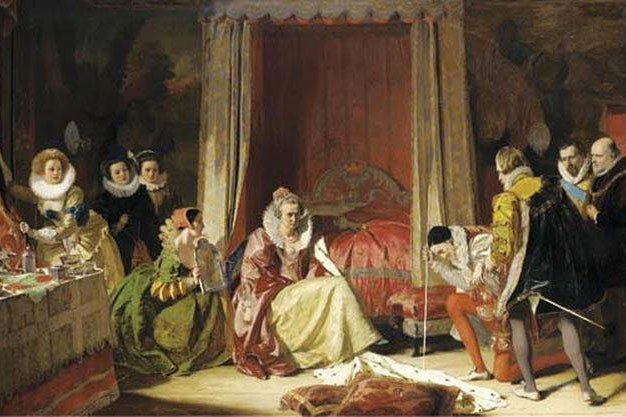
Dobson and Watson write that this new representation of Elizabeth as a decaying woman was as well a critique of the monarchy. "By destroying Elizabeth's magical agelessness, a fundamental component of contemporary nationalist Elizabethan nostalgia," Egg's painting made a commentary on England's current country. Fifty-fifty children's books in the Victorian period used Elizabeth's vanity to teach a moral lesson. "With all her courage," children's magazine Bow Bells wrote, " 'good Queen Bess' had not strength of mind to look her wrinkles in the confront."
Yet some—exist it out of royalist sentiment or gallantry—continued to defend Elizabeth. Dobson and Watson point to author Charles Kingsley, who argued in 1855: "Men had accepted [Elizabeth's youthful beauty] as what beauty of course and expression by and large is, an outward and visible sign of the inward and spiritual grace; and while the inward was unchanged, what wonder if she tried to preserve the outward? If she was the same, why should she not try to await the same?"
Lead pulverization remained in apply through the 19th century, when Eldridge writes that "the rise of women's journals meant that women shared their findings and became more savvy about potentially harmful whiteners like arsenic and lead." But some women didn't get the message. Historian Kathy Peiss writes that a nineteenth-century American dr. reported in a medical periodical the case of "Mary C.," a housewife in St. Louis who used a commercial skin lightener, sold as "Laird's Bloom of Youth," for years, before beingness admitted to a hospital in 1877 with her arms paralyzed. This patient eventually died of pb poisoning; the doctor, Peiss writes, "condemned women'due south vanity as he exposed a dangerous commercial production."
The employ of pb in cosmetics seems like a preposterous relic of history now. But lead powder, whether used by Elizabeth (in myth or truth) or the American Mary C., was an expensive product that slowly sapped women's forcefulness, fifty-fifty every bit it promised an extension of their meager ability. In that, it's painfully familiar.
Source: https://slate.com/technology/2018/12/queen-elizabeth-makeup-margot-robbie-mary-queen-of-scots-real-story.html
Posted by: burtonroomens.blogspot.com
0 Response to "What Did Elizabeth 1 Use For Makeup"
Post a Comment