

What Is The Chemical Makeup Of Each Molecule In Dna
2. Each Deoxyribonucleic acid strand is composed of nucleotides—units fabricated up of a sugar (deoxyribose), a phosphate group, and a nitrogenous base.
Each strand of DNA is a polynucleotide composed of units chosen nucleotides. A nucleotide has iii components: a sugar molecule, a phosphate group, and a nitrogenous base.
The sugar in Deoxyribonucleic acid's nucleotides is chosen deoxyribose—Dna is an abbreviation for deoxyribonucleic acid. RNA molecules employ a unlike sugar, called ribose. Covalent bonds join the sugar of i nucleotide to the phosphate grouping of the next nucleotide, forming the Dna strand'south sugar-phosphate backbone.
A nitrogenous base of operations is an organic molecule that contains nitrogen and has the chemic properties of a base of operations. There are four nitrogenous bases that occur in Deoxyribonucleic acid molecules: cytosine, guanine, adenine, and thymine (abbreviated as C, Thousand, A, and T). RNA molecules contain cytosine, guanine, and adenine, merely they have a different nitrogenous base, uracil (U) instead of thymine.
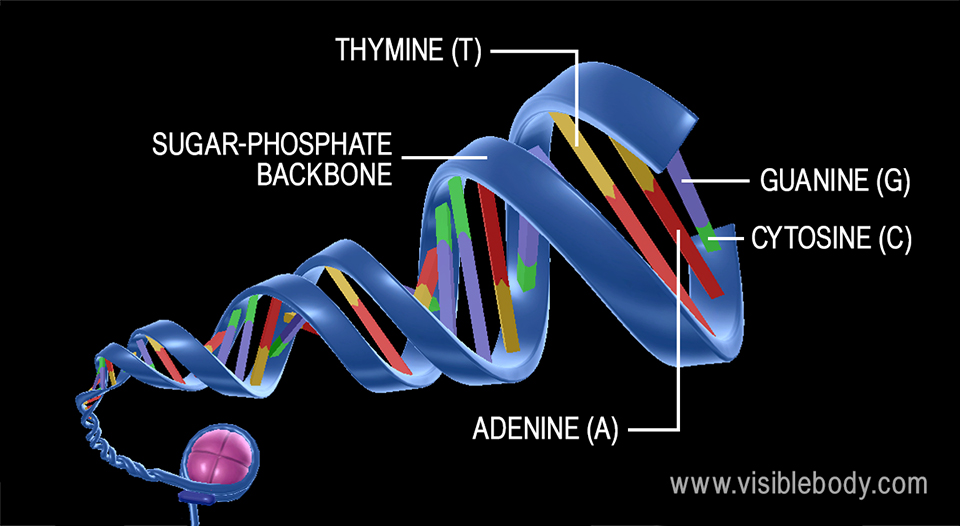
3. The sequences of nitrogenous bases on the 2 strands of a Dna molecule are complementary.
The sequence of nitrogenous bases on ane strand of a DNA molecule's double helix matches up in a item way with the sequence on the other strand. Adenine pairs with thymine and cytosine pairs with guanine.
Why practise the nitrogenous bases pair in this specific way? The bases on each strand are joined to the bases on the other strand with hydrogen bonds, merely unlike bases accept different chemical structures. Cytosine and thymine (and uracil in RNA) are pyrimidines, containing 1 band. Adenine and guanine are purines, containing two rings. The pyrimidines pair with the purines: cytosine and guanine form three hydrogen bonds, and adenine and thymine form two.
four. Specific sequences of nitrogenous bases that code for detail proteins or regulatory RNA molecules are called genes.
Each strand of DNA is similar a recipe book for synthesizing proteins. Certain sequences of nitrogenous bases along the strand encode particular RNA molecules. These sequences are called genes. mRNA molecules transcribed from genes are translated into proteins later.
Chromosomes can vary widely in their number of base pairs and genes. The longest chromosome in human being cells, Chromosome 1, is around 249 million base pairs long and has between 2000 and 2100 distinct genes. Chromosome 21, the shortest man chromosome, consists of 48 million base pairs and contains between 200 and 300 genes. Overall, prokaryotic cells have shorter chromosomes with fewer genes. For case, the bacterium Carsonella rudii has only 159,662 base pairs and 182 genes in its unabridged genome.
Although genes get most of the credit for what Deoxyribonucleic acid does, they make up only well-nigh ane% of DNA (in humans). Genes are separated from one another past sequences of nitrogenous bases that don't provide instructions for RNA synthesis. These are chosen intergenic regions. Fifty-fifty within genes, there are regions of noncoding Dna called introns.
Noncoding regions of DNA are important considering they provide binding sites for proteins that assist activate or deactivate the process of transcription. They can also provide protection for the coding regions. For case, telomeres consist of repetitive sequences that protect the genetic information on each DNA molecule from being damaged during cell segmentation.
Source: https://www.visiblebody.com/learn/biology/dna-chromosomes/dna-structure
Posted by: burtonroomens.blogspot.com
0 Response to "What Is The Chemical Makeup Of Each Molecule In Dna"
Post a Comment