

Which Algal Group Has Chloroplasts Much Like Those Of Green Plants In Structure And Pigment Makeup
5.iii.iii: Red and Green Algae
- Page ID
- 31929

Learning Objectives
- Distinguish betwixt unlike groups of algae using life cycle, morphological features, and cellular composition.
- Connect adaptations in the cherry and dark-green algae to habitat characteristics and ecology.
- Identify structures and phases in the Polysiphonia and Spirogyra life cycles; know the ploidy of these structures.
Ruddy algae and green algae are included in the supergroup Archaeplastida. It was from a common ancestor of these protists that the land plants evolved, since their closest relatives are found in this group. Molecular evidence supports that all Archaeplastida are descendants of an endosymbiotic relationship between a heterotrophic protist and a cyanobacterium. This primary endosymbiosis resulted in the chloroplasts of all photosynthetic eukaryotes discussed in this book! The red and light-green algae include unicellular, multicellular, and colonial forms.
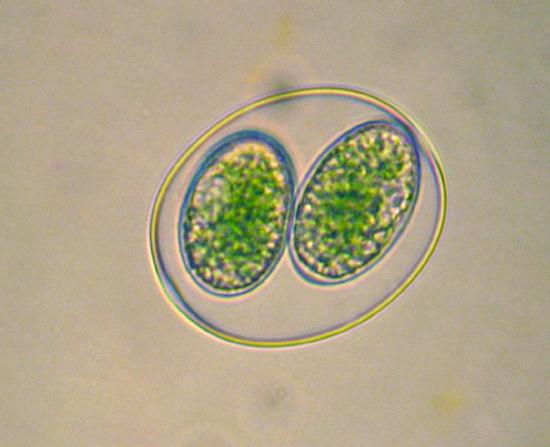
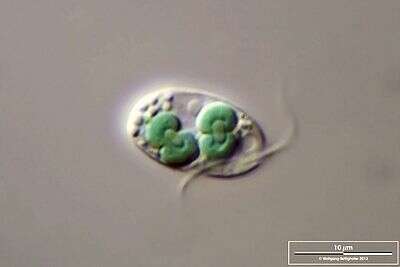
Glaucophyta
Glaucophytes are unicellular, phototrophic eukaryotics institute in freshwater ecosystems. Glaucophytes are likely an ancestral branch in the Archaeplastida and are often used every bit prove of the cyanobacterial origin of chloroplasts. They accept chloroplast-similar organelles, called cyanelles or muroplasts, that have peptidoglycan between the two membranes. They accept the same pigments as blue-green alga and reddish algae: chlorophyll a and phycobilins. Much like the cyanobacteria, they announced blue-greenish due to the interaction of chlorophyll and phycocyanins (glauco- comes from the Greek glaukos significant blue-green). Non-motile cells have a rigid cell wall composed of cellulose. Motile cells have two whiplash flagella. Sexual reproduction has even so to exist documented in this grouping.
Rhodophyta
Ruby-red algae descended from the same endosymbiotic upshot every bit the Glaucophyta. The scarlet algae are about exclusively marine. Some are unicellular but most are multicellular. Approximately 6,000 species accept been identified. They have true chloroplasts with ii membranes (no remnant peptidoglycan) containing chlorophyll a. Like the cyanobacteria, they use phycobilins every bit antenna pigments - phycoerythrin (which makes them red) and phycocyanin. Cerise paint allows the red algae to photosynthesize at deeper depths than the greenish or brown algae, harnessing more of the blueish light waves that penetrate deeper into the water cavalcade. Unlike green algae and plants, cerise algae store carbohydrates equally Floridean starch in the cytosol. Some are used as food in coastal regions of Asia. Agar, the base of operations for culturing bacteria and other microorganisms, is extracted from a cherry-red alga.
Selection Pressures and Drivers
An important aspect of understanding the life history traits of the Rhodophyta is understanding the challenges of living in a marine environment.
- Admission to sunlight: Most colors of light cannot penetrate into deeper water, as they are scattered by water molecules. The wavelengths of light that reach deepest into the ocean are blue and green. Many fish that live in the deep bounding main are cherry-red. Because red light does not penetrate to the depths where they alive, this makes them almost undetectable by sight. Remember, we encounter things because of the light that bounces off of them. Cherry pigments reflect ruddy light, so no red light, no reflected light. Red algae are using a similar strategy--absorb the wavelengths of light that are not cerise--with a different goal: to use that absorbed light to make food. The phycoerythrin in their chloroplasts reflects reddish light, giving them a cerise advent, and absorbs the blueish light that is able to penetrate to deeper areas in the water column.
- Fertilization: The sea is an expansive surroundings, oft with large areas of open space betwixt populations of organisms. In this surround, successful fertilization of an egg by a nonmotile sperm--red algae lack flagella--presents a challenge. Having multicellular haploid and diploid phases provides red algae more opportunities to produce gametes and spores. A diploid stage that clones the zygote, the carposporophyte, provides more opportunities to practise meiosis from each fertilization outcome.
- Salinity: Marine environments are relatively high in salinity. A possible adaptation for this is to have sulfated polysaccharides in the prison cell wall, such equally the galactans nowadays in Rhodophyta. This is a strategy present in (potentially all) marine algae and is inferred to be an adaptation for salinity-tolerance. See this open-access article for farther information.
Morphology
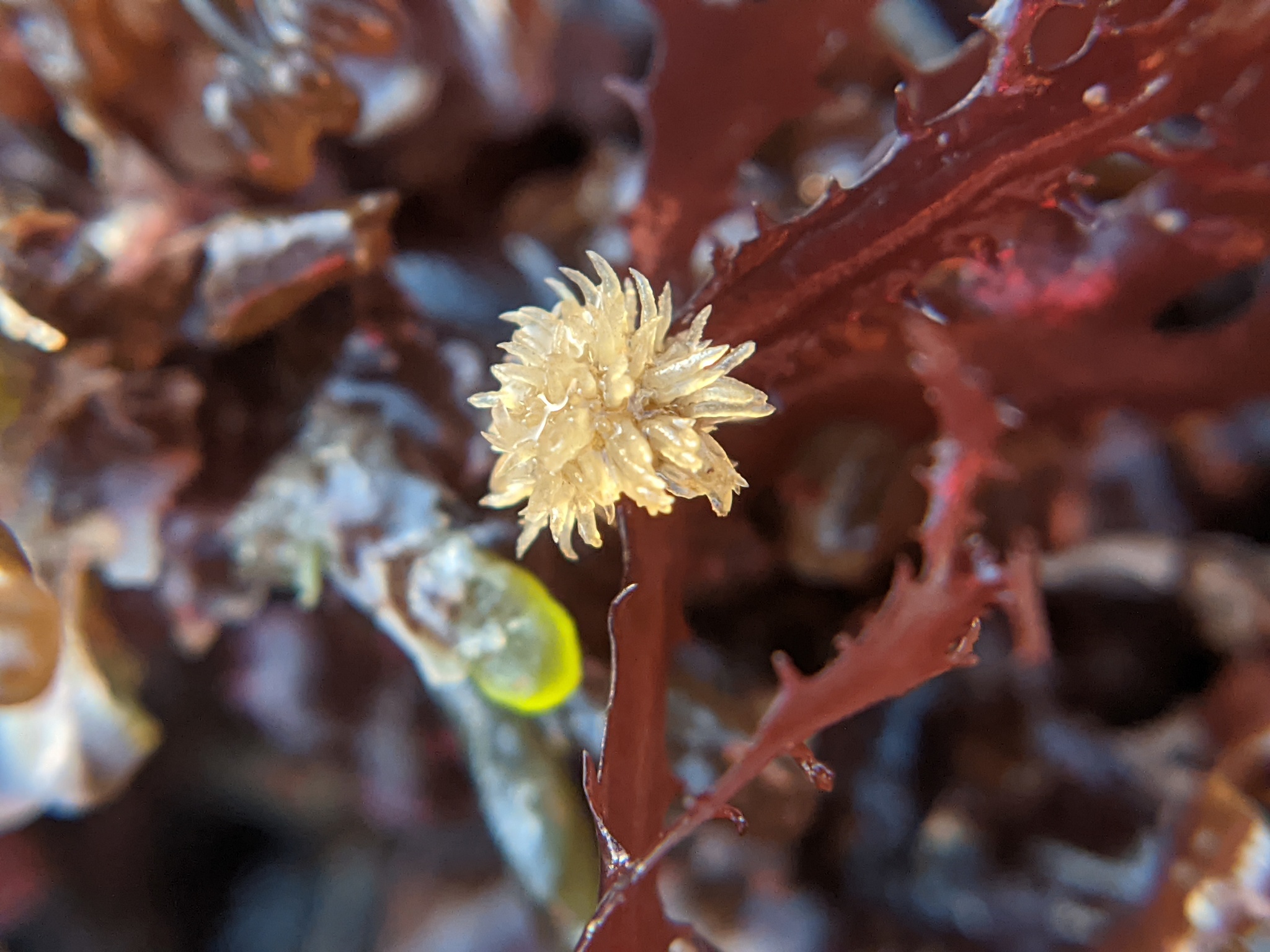
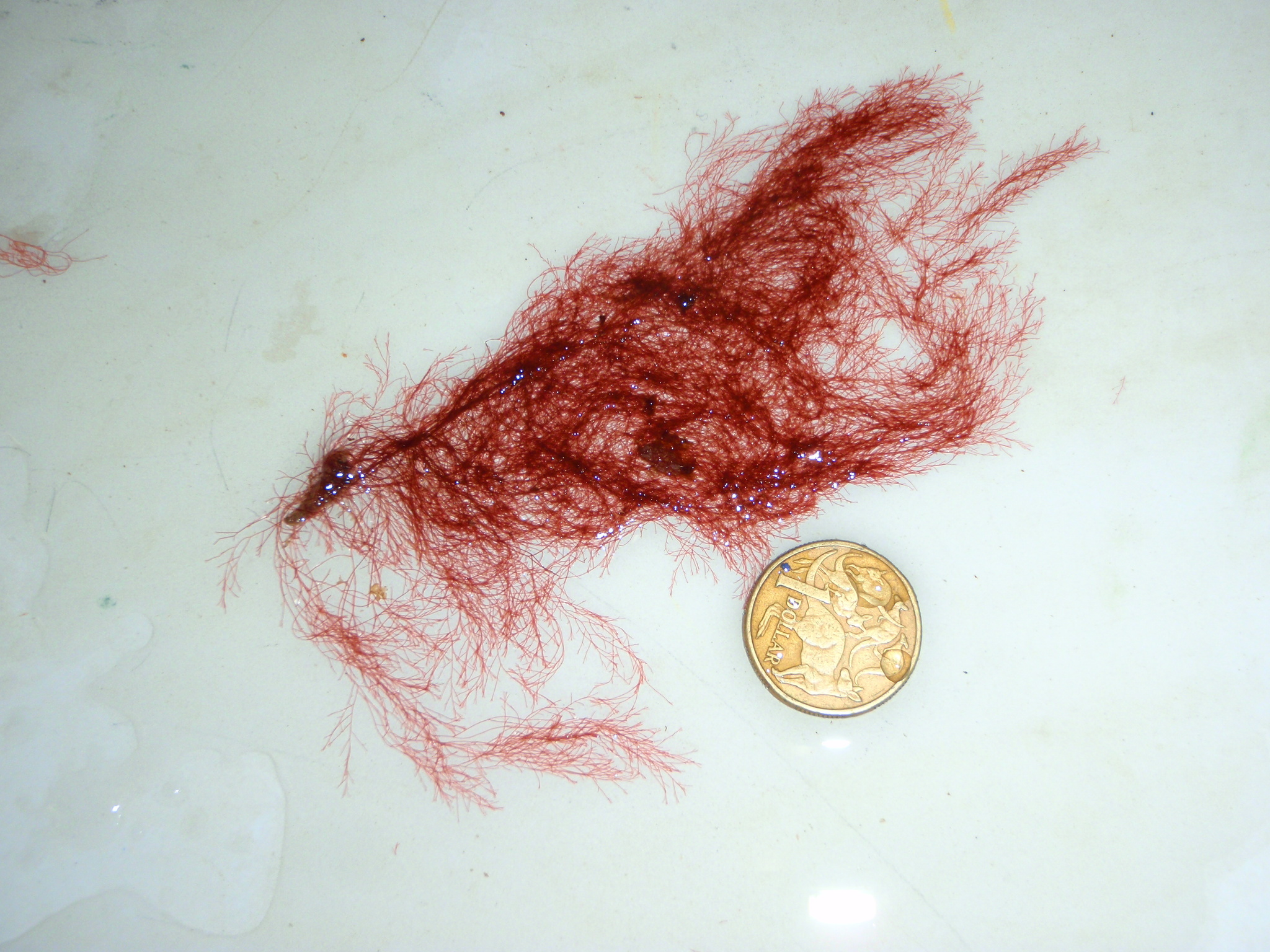
Cerise algae accept a various range of morphologies. Unicellular forms may live solitarily or as colonies just, unlike other members of the Archaeplastida, lack flagella. Flagella are absent from the Rhodophyta, lost at some point in their evolutionary history. Multicellular forms can exist filamentous, leafy, canvass-similar, coralloid, or even crust-similar (some examples in Figure \(\PageIndex{4}\) and Figure \(\PageIndex{5}\)). The strange coralline crimson algae have calcerous deposits in the cell walls that make the thallus difficult, like a coral. These can take a variety of forms and are able to live at depths other algae cannot (over 500 feet deep for some!).
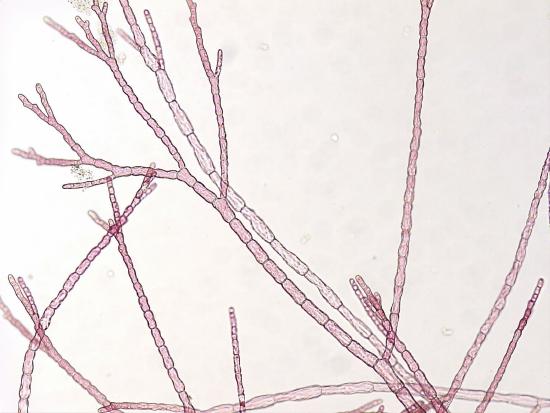
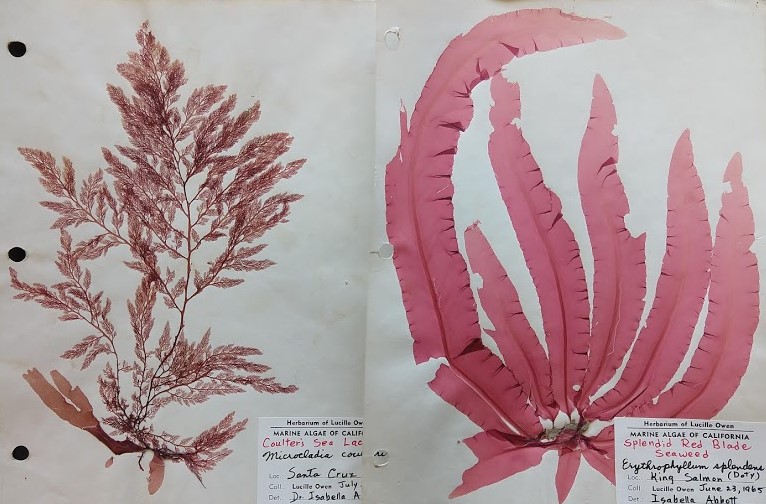
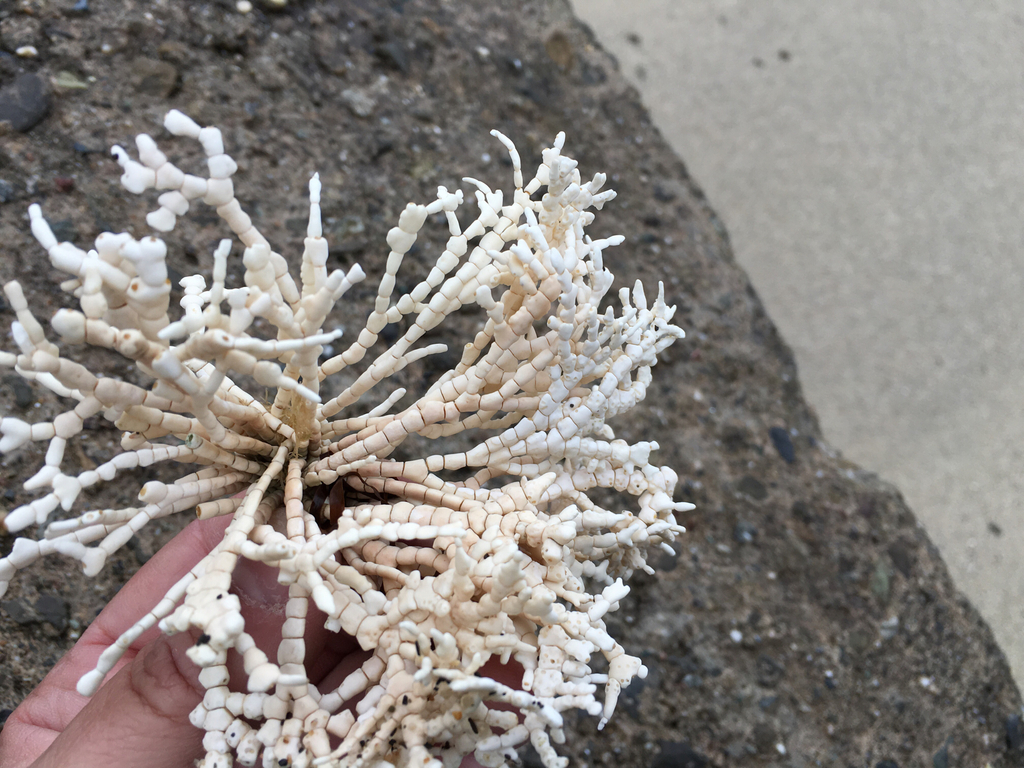
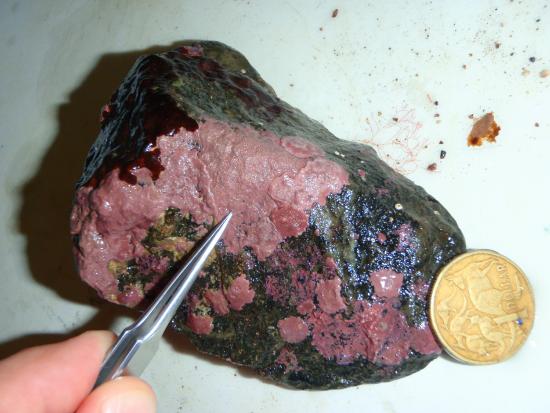
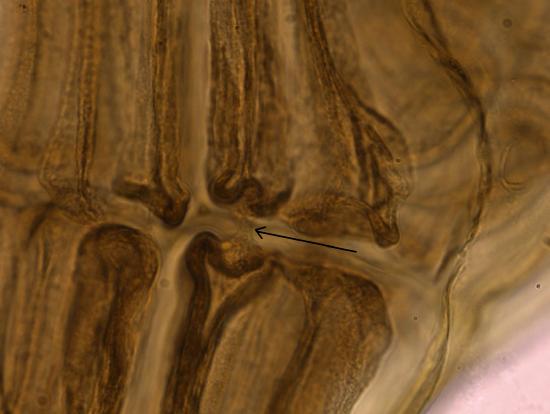
Cells of multicellular species are connected via incomplete cytokinesis, resulting in pit connections (Figure \(\PageIndex{6}\)).
Polysiphonia Life Cycle
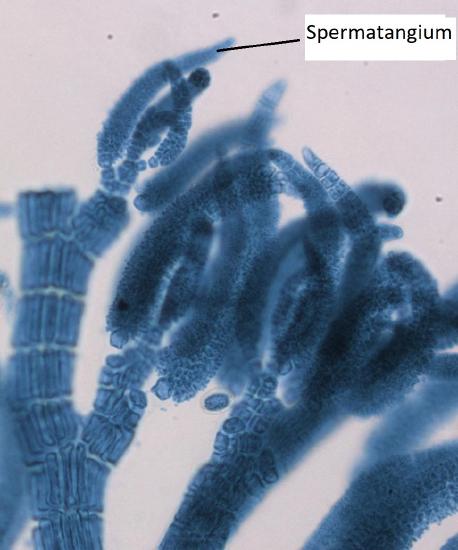
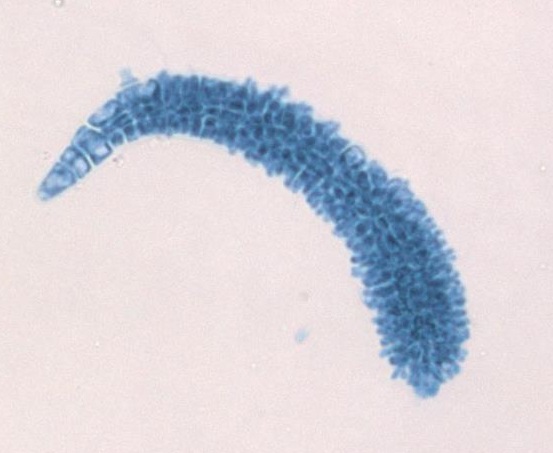
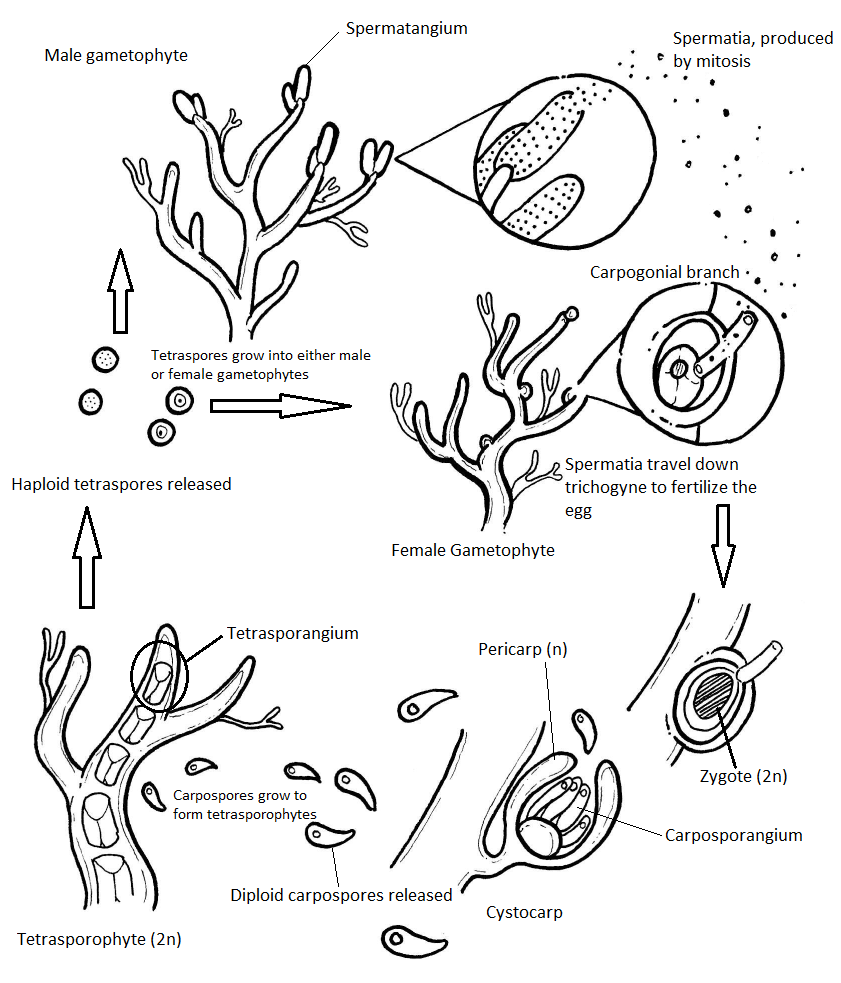
Red algae take a haplodiplontic (alternation of generations) life cycle that has an actress diploid stage: the carposporophyte. Polysiphonia is the model organism for the Rhodophyta life cycle. The gametophytes of Polysiphonia are isomorphic (iso- meaning same, morph- meaning form), meaning they have the same basic morphology. Any divergence y'all see in coloration of the images in this section is due to staining. They would all announced a deep red color in an unstained slide.
Male Gametophyte
The male gametophyte has elongated structures that emerge from the tips of the thallus branches. These are spermatangia, where spermatia are produced past mitosis.
Female person Gametophyte and Carposporophyte
The female gametophyte produces an egg that is independent within a construction called the carpogonium. This structure has a long, sparse projection called a trichogyne (trich- meaning hair, -gyne meaning female). During fertilization, a spermatium fuses with the trichogyne and the nucleus of the spermatium travels down the tube to the egg. When the nucleus of the spermatium fuses with the egg, a zygote is produced. This zygote is retained and nourished by the female gametophyte as information technology grows.
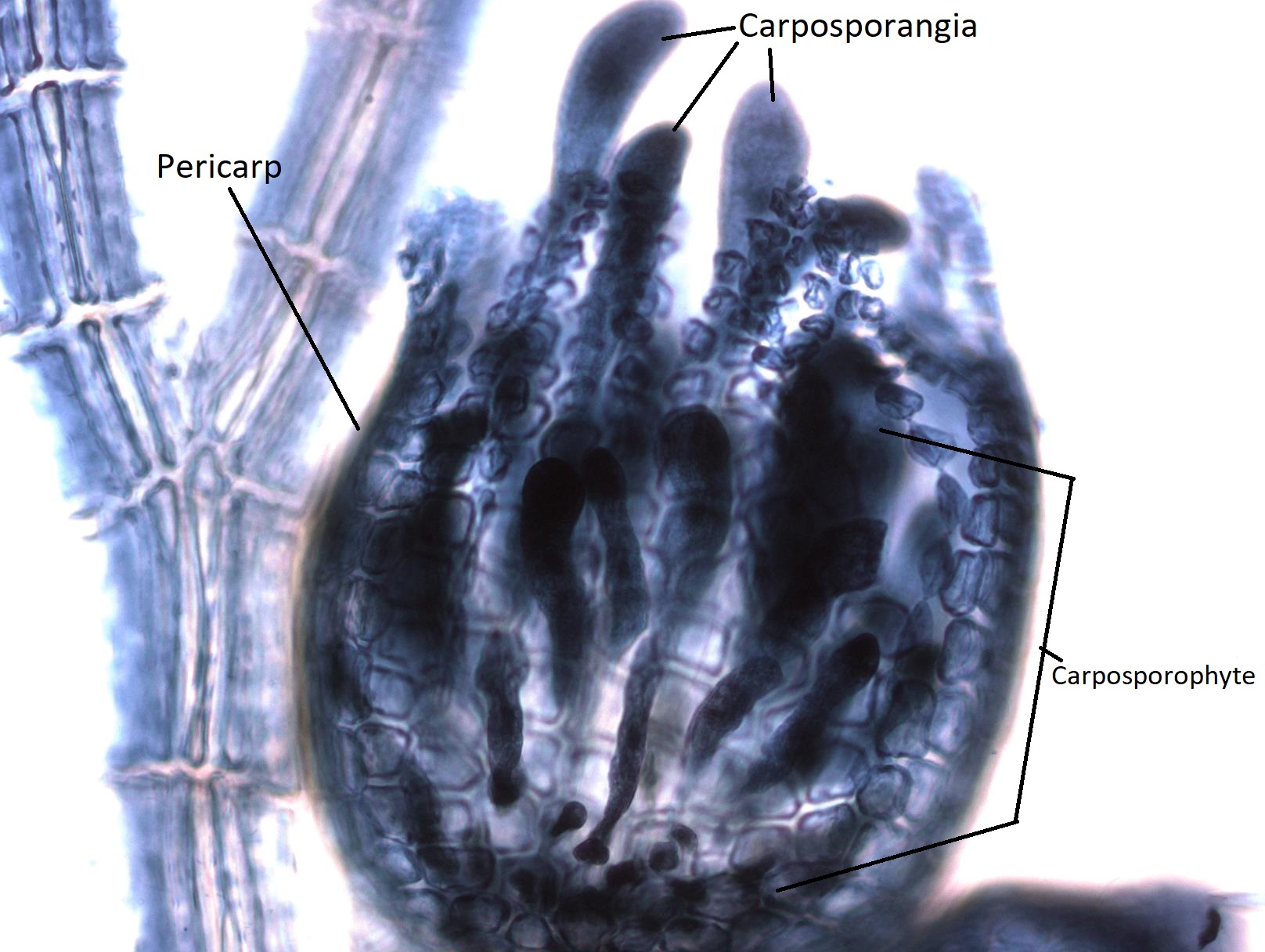
The globose structures you see growing from the female gametophyte thallus are chosen cystocarps. A cystocarp is composed of both female gametophyte tissue (north) and carposporophyte tissue (2n). The outer layer of the cystocarp, the pericarp (peri- meaning around) is derived from the female person gametophyte and is haploid. The interior of the cystocarp consists of the carposporophyte, which is diploid, and produces structures called carposporangia, inside of which it produces carpospores past mitosis. All of these--carposporophyte, carposporangia, and carpospores--are diploid.
Tetrasporophyte
The diploid carpospores are released into the bounding main waters, where they will be carried on currents to some other location. If a carpospore lands in an appropriate environment, it will grow by mitosis into a tetrasporophyte (2n). The tetrasporophyte produces tetrasporangia (2n) within the branches of the thallus. Each tetrasporangium produces four unique, haploid tetraspores past meiosis. Tetraspores (n) are released and volition grow by mitosis into either male or female person gametophytes, completing the life cycle.
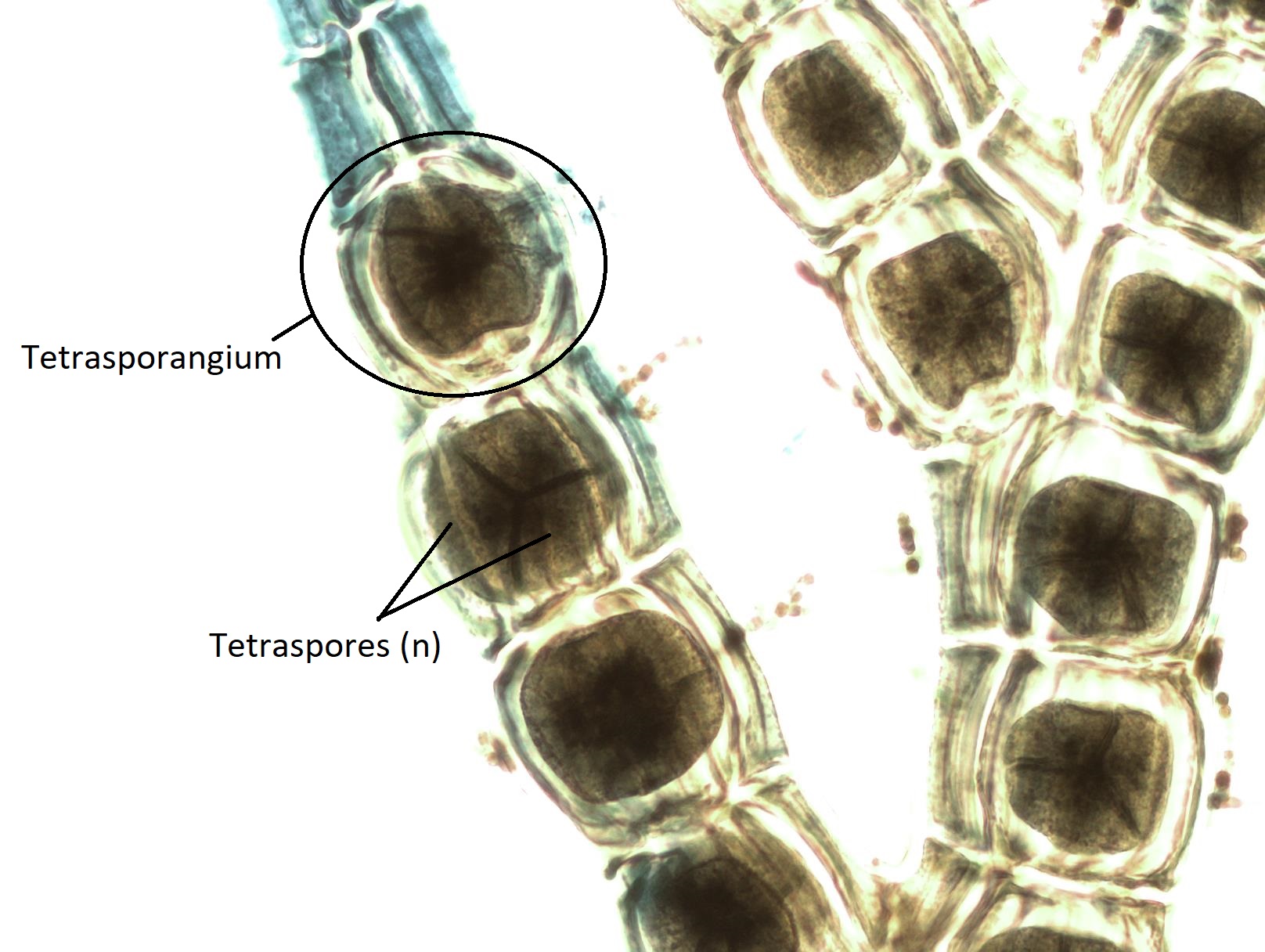
Total Life Wheel Diagram
Summary of Characteristics for Blood-red Algae
- Morphology: Unicellular to multicellular, no flagellated stages. Cells of multicellular species are connected via incomplete cytokinesis, resulting in pit connections.
- Cell wall composition: Cellulose and galactans
- Chloroplasts: 2 membranes, pigments are chlorophyll a and phycobilins (primarily phycoerythrin, providing their red color)
- Storage carbohydrate: Floridean starch
- Life cycle: Alternation of generations with an extra diploid stage, the carposporophyte
- Ecology: Primarily marine (97% of species)
Green Algae
The most arable group of algae is the light-green algae. The nature of the evolutionary relationships between the green algae are still up for debate. Equally of 2019, genetic data supports splitting the greenish algae into two major lineages: chlorophytes and streptophytes. The streptophytes include several lineages of green algae (such as the charophytes) and all country plants. Streptophytes and chlorophytes represent a monophyletic group called Viridiplantae (literally "dark-green plants"). The green algae exhibit similar features to the state plants, specially in terms of chloroplast structure. They have chlorophyll a and b, have lost phycobilins but gained carotenoids, and store carbohydrates as starch inside plastids. Although some of the multicellular forms are large, they never develop more a few types of differentiated cells and their fertilized eggs do not develop into an embryo.
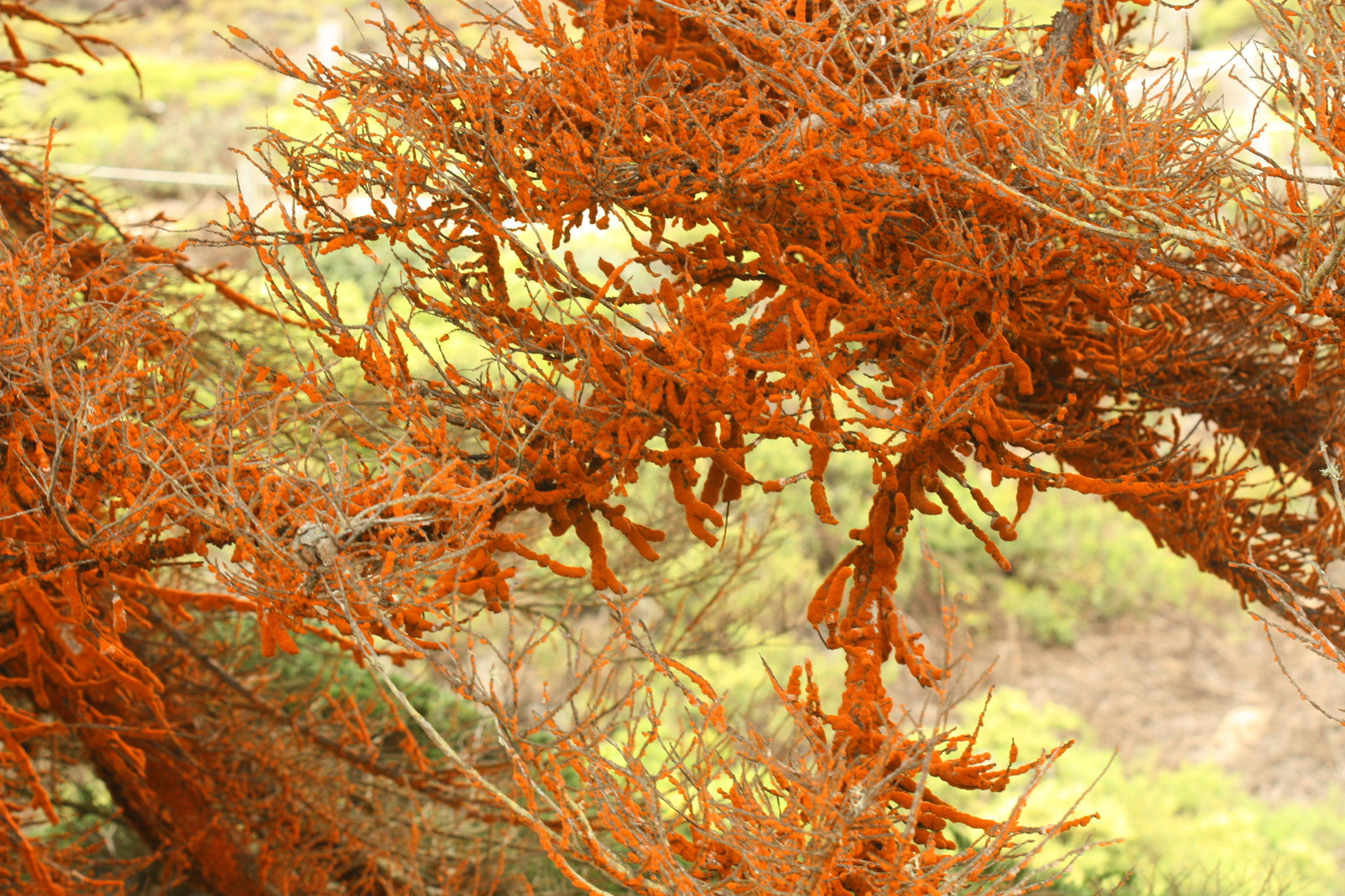
Greenish algae are an important source of food for many aquatic animals. When lakes and ponds are "fertilized" with phosphates and nitrates (e.grand., from sewage and the runoff from fertilized fields and lawns), dark-green algae ofttimes grade extensive algal "blooms". Members of this group tin be constitute in freshwater and marine habitats, and many have adapted to life on state, either inside of lichens or costless-living (come across Figure \(\PageIndex{12}\)).
Choice Pressures and Drivers
- Sun Harm. Green algae represent a diverse group of organisms with diverse life history traits, many of which are shared with country plants. The development of carotenoids-- yellow, orange, and cerise pigments that deed in both light harvesting and sun protection--offers this group increased access to sunlight while simultaneously protecting against UV impairment. UV rays do not penetrate very far into the water column, and so organisms moving into shallower waters or terrestrial environments would need to deal with this new challenge. Many terrestrial species of dark-green algae appear orangish, rather than greenish, due to the production of large amounts of carotenoids.
Morphology
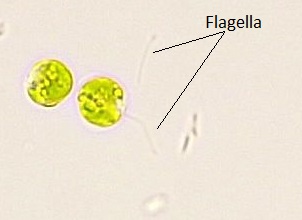
These algae exhibit great multifariousness of grade and part. Like to ruby algae, light-green algae can be unicellular or multicellular. Many unicellular species grade colonies and some green algae be as big, multinucleate, single cells. Green algae primarily inhabit freshwater and damp soil, and are a mutual component of plankton. Chlamydomonas is a elementary, unicellular chlorophyte with a pear-shaped morphology and 2 opposing, anterior flagella that guide it toward lite sensed by its eyespot (Figure \(\PageIndex{xiii}\)). More circuitous species exhibit haploid gametes and spores that resemble Chlamydomonas.
The alga Volvox is ane of a colonial organism, which behaves in some means similar a collection of individual cells, but in other ways like the specialized cells of a multicellular organism (Effigy \(\PageIndex{14}\)). Volvox colonies comprise 500 to 60,000 cells, each with two flagella, independent within a hollow, spherical matrix composed of a gelatinous glycoprotein secretion. Individual Volvox cells movement in a coordinated fashion and are interconnected by cytoplasmic bridges. But a few of the cells reproduce to create daughter colonies, an instance of basic cell specialization in this organism.
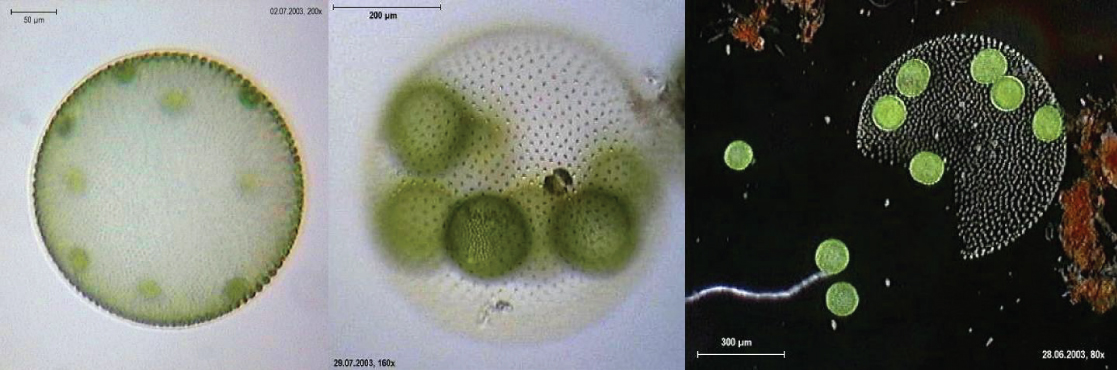
Volvox can reproduce both asexually and sexually. In asexual reproduction, the gonidia develop into new organisms that suspension out of the parent (which then dies). In sexual reproduction, the presence of an inducing chemical causes the following:
- The gonidia of the males to develop into clusters of sperm.
- The gonidia of the females to develop into new spheres each of whose own gonidia develops into a pair of eggs.
- The sperm break out of the male parent and swim to the female where they fertilize her eggs.
- The zygotes course a resting stage that enables Volvox to survive harsh conditions (Figure \(\PageIndex{xv}\)).
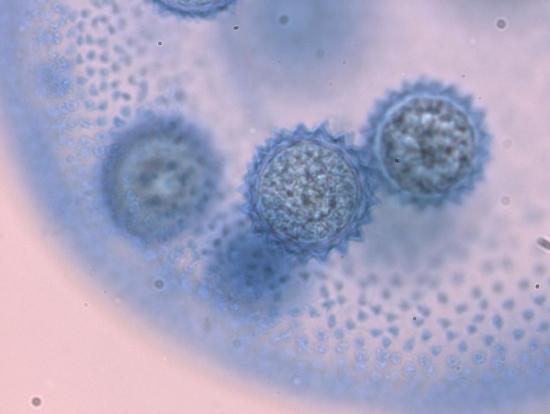
Video \(\PageIndex{one}\): This video shows how sexual reproduction occurs in the colonial green alga Volvox. Sourced from YouTube.
The genome of Volvox carteri consists of 14,560 protein-encoding genes - merely 4 more genes than in the unmarried-celled Chlamydomonas reinhardtii! Most of its genes are also plant in Chlamydomonas. The few that are not encode the proteins needed to form the massive extracellular matrix of Volvox.
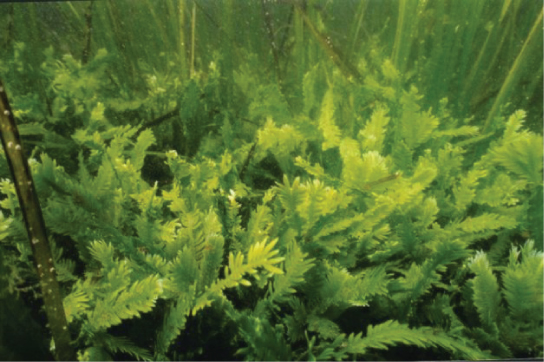
Species in the genus Caulerpa exhibit flattened fern-similar foliage and can reach lengths of 3 meters (Effigy \(\PageIndex{16}\)). Caulerpa species undergo nuclear division, simply their cells exercise non complete cytokinesis, remaining instead every bit massive and elaborate single cells.
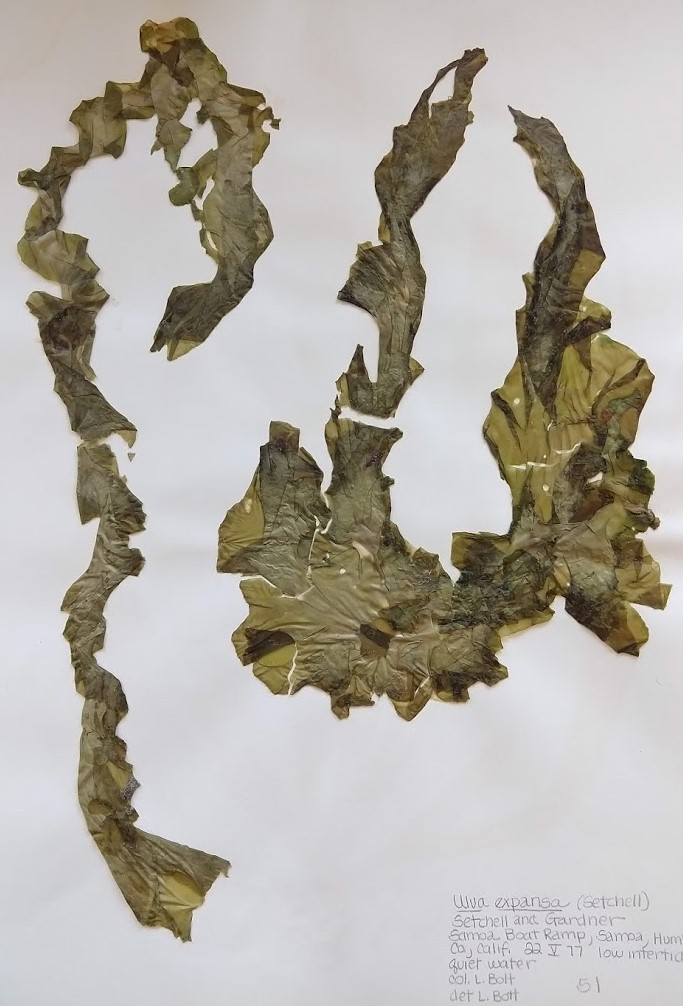
Truthful multicellular organisms, such every bit the body of water lettuce, Ulva, are also represented amongst the green algae (Figure \(\PageIndex{17}\) and Figure \(\PageIndex{18}\)).
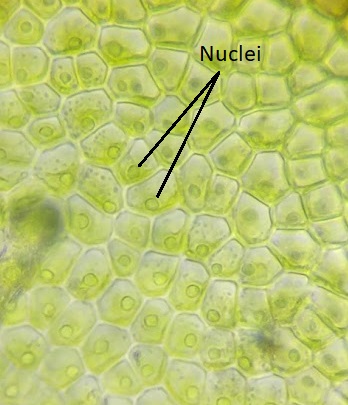
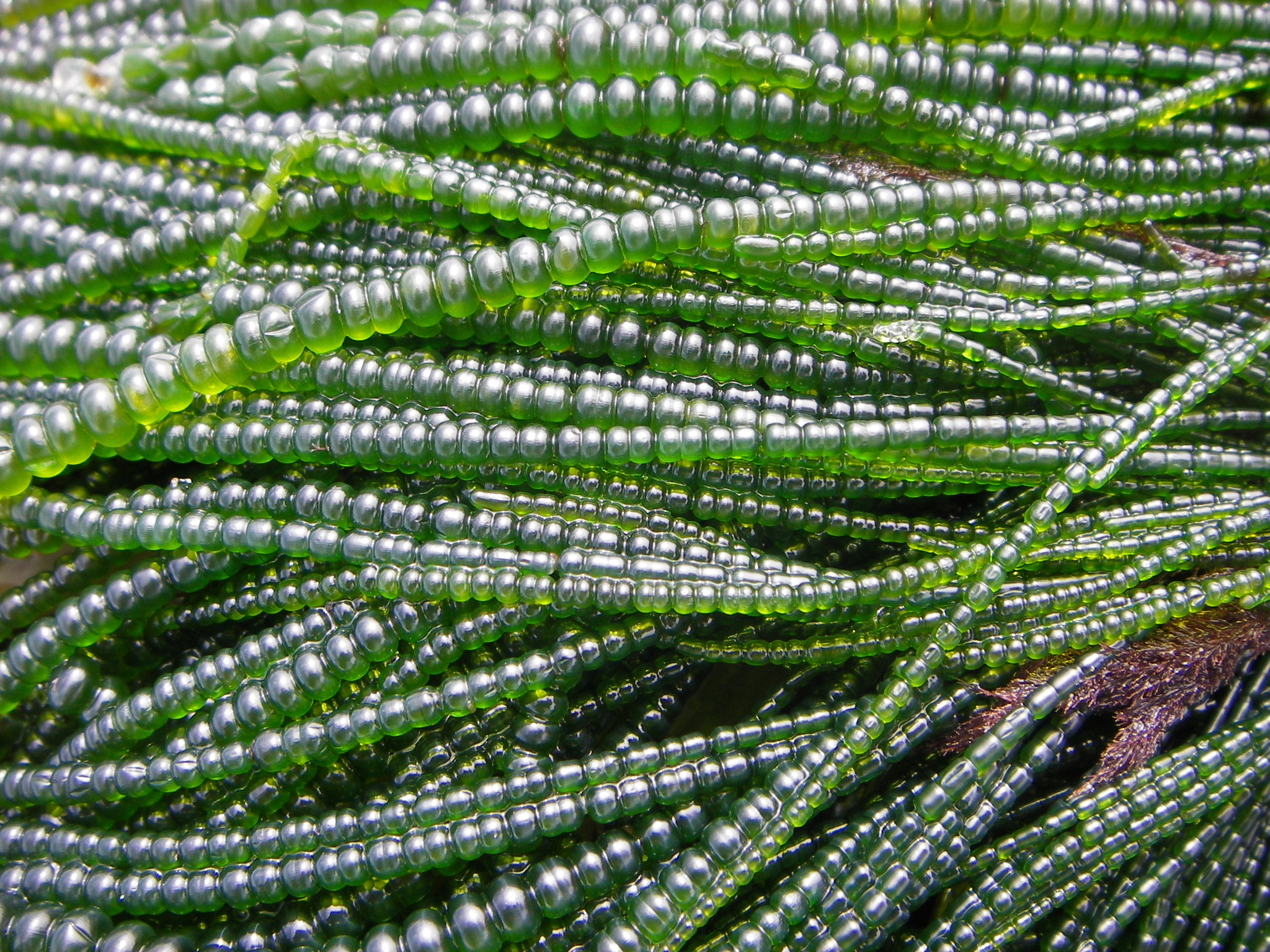
Spirogyra Life Wheel
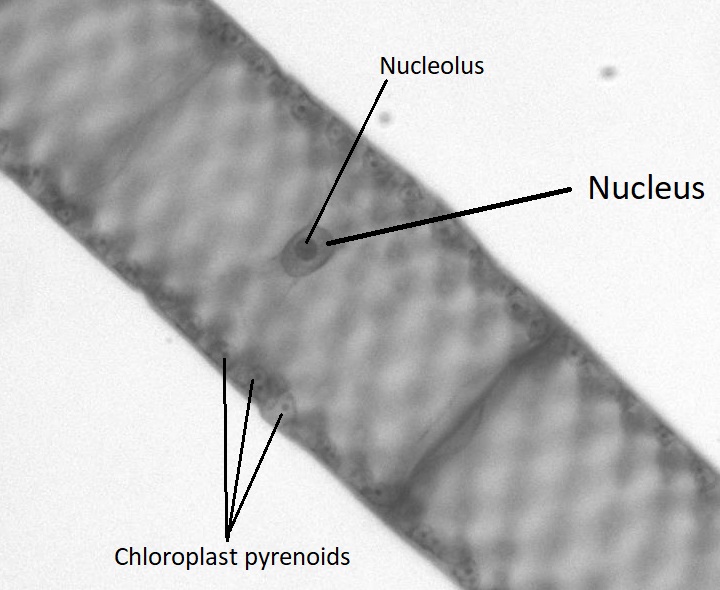
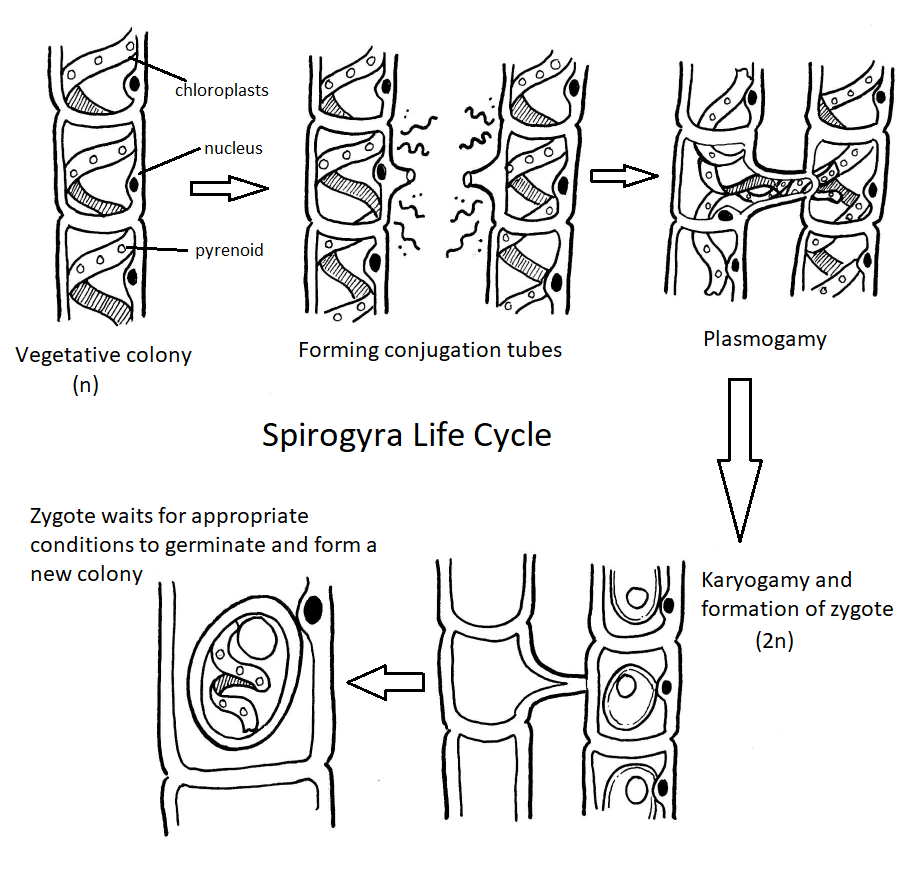
Though green algae display a diversity of life cycles, many have a haplontic life bicycle. A model organism for the dark-green algae is Spirogyra (Figure \(\PageIndex{19}\)). Spirogyra is a unicellular green algae that grows in long, filamentous colonies, making it appear to exist a multicellular organism. Even though it is technically unicellular, its colonial nature allows u.s.a. to classify its life cycle as haplontic. In the haploid vegetative cells of the colony, the chloroplasts are arranged in spirals, containing darkened regions chosen pyrenoids where carbon fixation happens. Each haploid jail cell in the filament is an private, which makes sexual reproduction between colonies an interesting procedure.
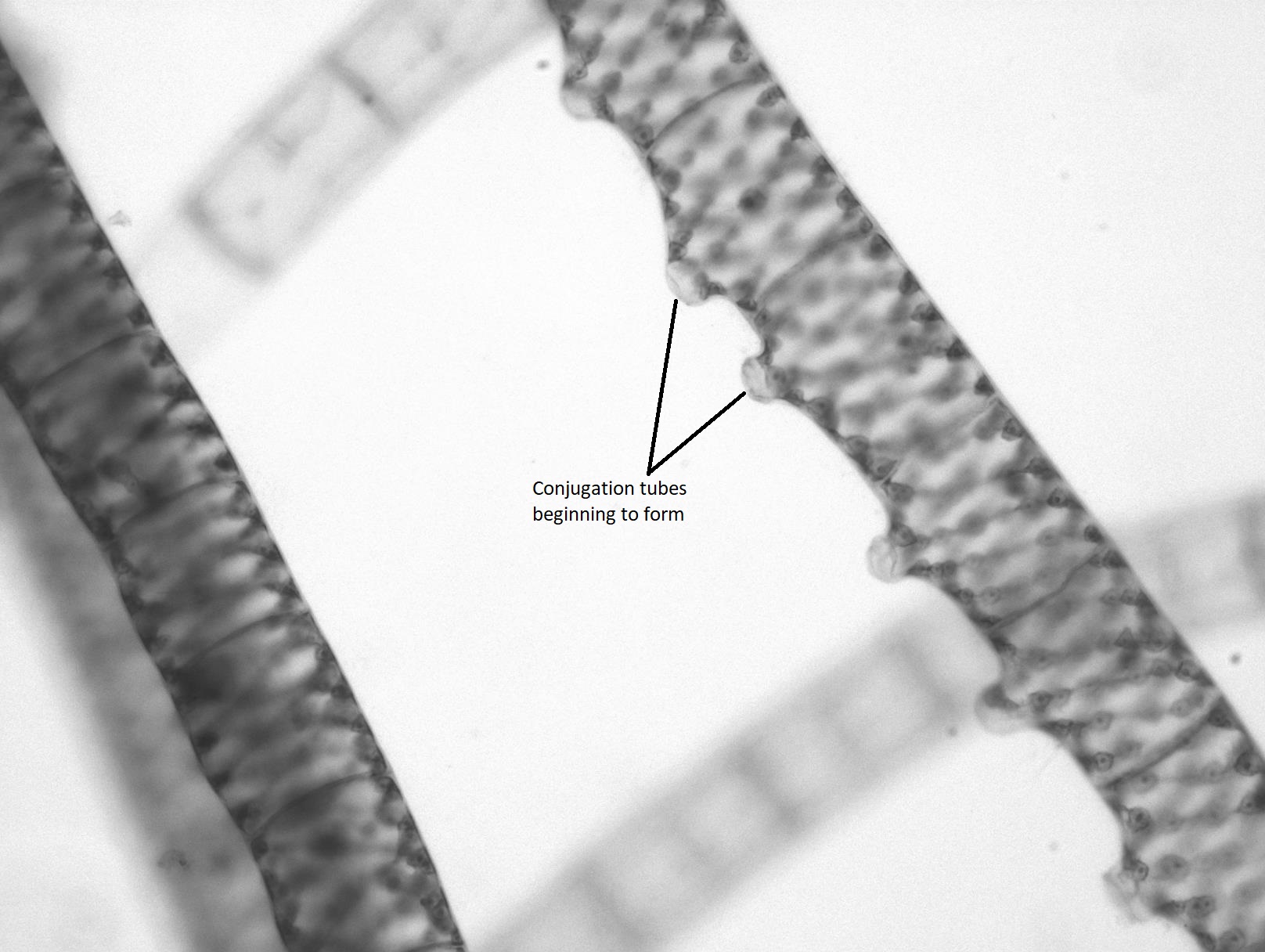
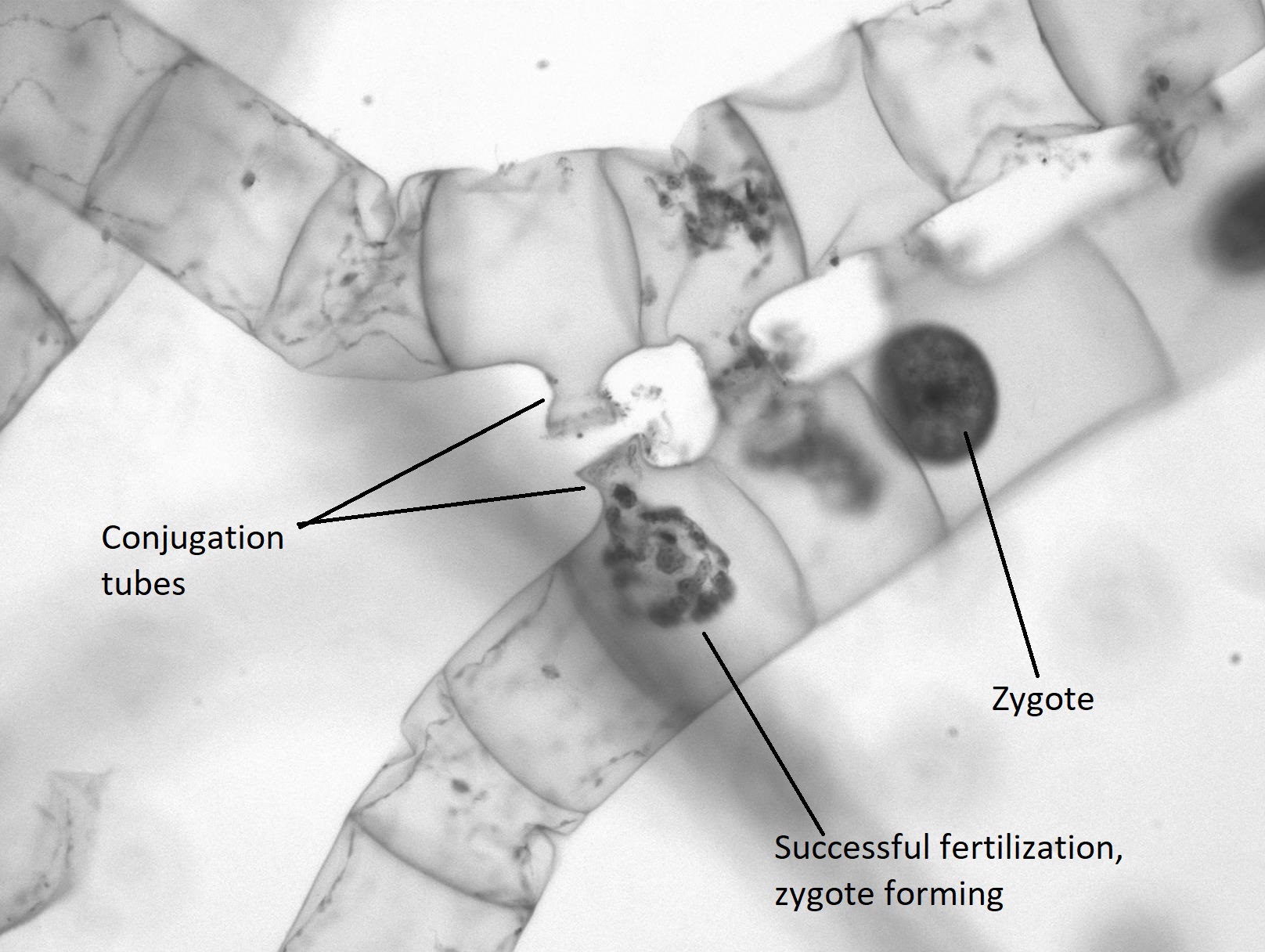
When two colonies of Spirogyra see that are of a complementary mating blazon (+/-), sexual reproduction occurs. The two colonies marshal, each jail cell across from a complementary jail cell on the other filament. A conjugation tube extends from each cell in ane colony (Figure \(\PageIndex{xx}\)), inducing formation of a tube on the cells in the other colony. The conjugation tubes from each colony fuse together.
The contents of one cell will move through the conjugation tube and fuse with the contents of the complementary prison cell, resulting in a diploid zygote (Figure \(\PageIndex{21}\)). The zygote appears as a large, egg-like structure contained within the complementary jail cell. Information technology has a thick wall that provides resistance to desiccation and cold, assuasive colonies of Spirogyra to overwinter, when needed. The other colony is now a filament of empty cells that will be broken down by some decomposer. When atmospheric condition are right, the zygote undergoes meiosis to produce another vegetative colony of haploid cells.
Full Life Cycle Diagram
Summary of Characteristics for Green Algae
- Morphology: Unicellular to multicellular; ii whiplash flagella on motile cells
- Jail cell wall composition: Cellulose
- Chloroplasts: 2 membranes, pigments are chlorophyll a, chlorophyll b, and carotenoids
- Storage carbohydrate: Starch
- Life cycle: Varies, but primarily haplontic. Some marine species have alternation of generations.
- Ecology: Freshwater, marine, and terrestrial species
Summary
Glaucophytes, red algae, and green algae are part of the Archaeplastida. These organisms are descended from the same primary endosymbiosis event. Glaucophytes are thought to be one of the earliest lineages to diverge due to the presence of remnant peptidoglycan between the membranes of its chloroplast-like cyanelles. Unsurprisingly, glaucophytes and red algae share the aforementioned pigments as Cyanobacteria.
Red algae (phylum Rhodophyta) are united by several synapomorphies (shared derived characteristics). They lack flagella, accept pit connections betwixt cells, and store carbohydrates equally Floridean starch. The sulfated galactans in their prison cell walls allows them increased fitness in marine environments, while the pigment phycoerythrin allows them to photosynthesize deeper in the h2o column. They have an alternation of generations life wheel with an actress diploid stage, the carposporophyte, that clones the zygote. These characteristics tin exist continued to the ecology stressors presented by the marine habitats most cerise algae are found in.
Green algae correspond several distinct lineages. Similar plants, they store carbohydrates equally starch within their plastids and have the pigments chlorophyll a and b, every bit well as carotenoids. Organisms in this group take haplontic (e.g. Spirogyra) or haplodiplontic (e.g. Ulva) life cycles. Many green algae are unicellular, forming complex colonies. Green algae can be institute in marine, freshwater, and terrestrial environments (including within lichens!).
Source: https://bio.libretexts.org/Bookshelves/Botany/Botany_(Ha_Morrow_and_Algiers)/Unit_1%3A_Biodiversity_(Organismal_Groups)/05%3A_Protists/5.03%3A_Photosynthetic_Protists/5.3.03%3A_Red_and_Green_Algae
Posted by: burtonroomens.blogspot.com
0 Response to "Which Algal Group Has Chloroplasts Much Like Those Of Green Plants In Structure And Pigment Makeup"
Post a Comment